Introduction
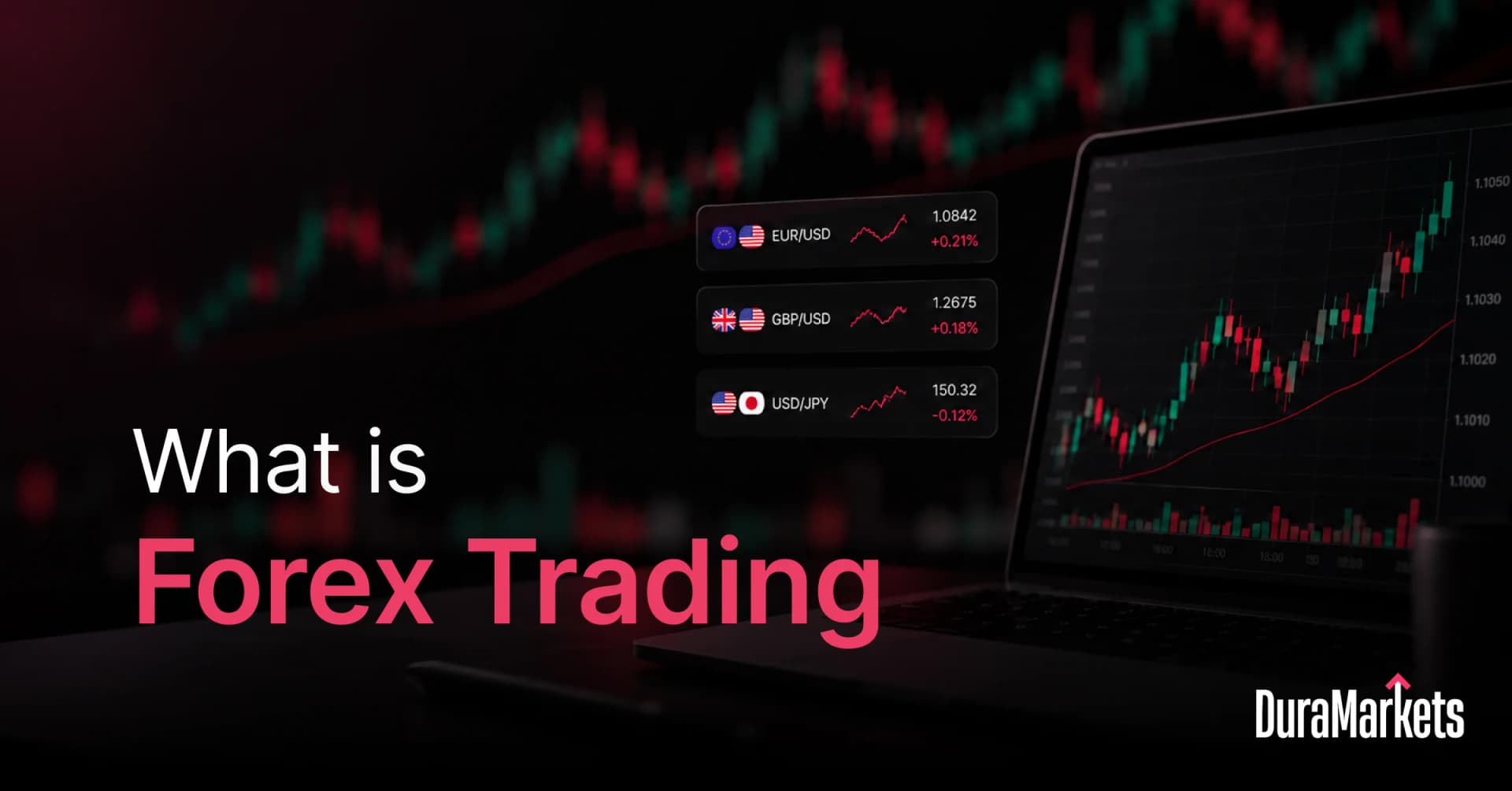
Forex trading is the buying and selling of currencies to benefit from changes in their exchange rates. It takes place in the foreign exchange market, where traders speculate on whether one currency will rise or fall against another.
This guide explains how forex trading works, how to read currency pairs and prices, when the market is active, what moves exchange rates, and how beginners can take their first steps while managing risk.
Who Trades in the Forex Market?
The foreign exchange market brings together different participants with different goals. Banks and financial institutions trade currencies for clients, manage their own exposure, and provide liquidity. Central banks may influence currency markets through monetary policy or foreign exchange operations.
Businesses use forex to convert money when paying international suppliers or receiving payments from overseas customers. Investment funds and other large institutions trade currencies to manage portfolios or seek returns.
Retail traders participate through brokers and trading platforms. They may trade currency pairs directly through available forex products or use Contracts for Difference (CFDs) to speculate on price movements without owning the currencies.
How Does Forex Trading Work?
Forex trading works by comparing the value of one currency against another. To understand how a trade is priced, start with currency pairs, spreads, pips, and leverage.
Understanding Currency Pairs
Forex is quoted in pairs because every exchange involves one currency against another. In EUR/USD, for example:
-
Base currency: EUR, the first currency in the pair.
-
Quote currency: USD, the second currency used to express the price.
If EUR/USD is quoted at 1.0850, one euro is worth 1.0850 US dollars at that quoted rate.
When a trader goes long (buys) EUR/USD, they expect the euro to strengthen against the dollar. When they go short (sell) EUR/USD, they expect the euro to weaken against the dollar. Whether the trade gains or loses depends on how the price moves after entry, along with trading costs.
Major, Minor and Exotic Pairs
Currency pairs are commonly grouped into three categories:
-
Major pairs: Include the US dollar and another widely traded currency, such as EUR/USD and GBP/USD.
-
Minor pairs: Combine major currencies without the US dollar, such as EUR/GBP and EUR/JPY.
-
Exotic pairs: Usually combine a major currency with one from an emerging or smaller economy, such as USD/INR and USD/TRY.
Major pairs generally have high trading activity, while exotic pairs may have wider spreads and lower liquidity.
According to the Bank for International Settlements’ 2025 survey, EUR/USD accounted for 21.2% of global OTC foreign exchange turnover, making it the most traded currency pair by this measure. Source: BIS Triennial Central Bank Survey.
Bid, Ask and the Spread
The bid price is the price at which you can sell, while the ask price is the price at which you can buy. The spread is the difference between them.
For example, if EUR/USD has a bid of 1.0848 and an ask of 1.0850, the spread is 0.0002, or 2 pips. This difference is a trading cost: a new buy position typically starts at the ask, while a sell position starts at the bid.
Spreads can change with liquidity, volatility, market conditions, and account type. Commissions may also apply. The bid price and ask price may vary based on the forex trading platforms.
Pips and Lot Sizes
A pip is a standard unit used to measure price movement in most forex pairs. For many pairs, one pip is 0.0001. For example, if EUR/USD moves from 1.0850 to 1.0860, it has risen by 10 pips. For yen pairs, one pip is commonly 0.01.
A lot measures trade size:
-
Standard lot: 100,000 units of the base currency.
-
Mini lot: 10,000 units.
-
Micro lot: 1,000 units.
For example, a 0.10-lot EUR/USD position represents 10,000 euros. The monetary value of each pip depends on the position size and the currencies involved.
Leverage and Margin
Leverage lets you control a larger position with a smaller amount of money deposited as margin. For example, with 10:1 leverage, $1,000 in margin could provide exposure to a $10,000 position, subject to the broker’s requirements.
A 1% move against that position would equal a $100 loss before costs—10% of the $1,000 margin used. Leverage magnifies losses as well as gains, so even small market movements can have a significant impact on your account.
If your account equity falls too low, a broker may issue a margin call or close positions under its stop-out rules. Understand these requirements before trading.
Forex Market Hours and Trading Sessions
The forex market generally operates 24 hours a day, five days a week, as activity moves between major financial centres. The busiest periods depend on which sessions overlap and how much liquidity is available. The times below are approximate GMT reference windows; daylight saving changes can shift some sessions.
|
Trading session |
Approximate GMT hours |
Typical activity |
|
Sydney |
22:00–07:00 |
Often quieter, with activity in AUD and NZD pairs |
|
Tokyo |
00:00–09:00 |
Activity in JPY and other Asian currencies |
|
London |
08:00–17:00 |
High activity across many major pairs |
|
New York |
13:00–22:00 |
Strong activity, especially during the London overlap |
The London–New York overlap often sees substantial activity because two major financial centres are open at the same time. However, high activity can also mean sharper price movements. Always consider the currency pair and the economic calendar rather than assuming one session is always best. Source: FOREX.com market-hours guide.
What Moves Currency Prices?
Exchange rates respond to economic conditions, policy decisions, and changes in market sentiment. Common drivers include:
-
Interest rates and central bank decisions: If the European Central Bank signals higher rates while US rates are expected to fall, EUR/USD may rise as expectations around the currencies change.
-
Inflation and jobs data: Stronger-than-expected US employment figures may shift expectations about Federal Reserve policy and move the dollar.
-
Economic growth: If UK growth data disappoints while US data remains strong, GBP/USD could come under pressure.
-
Geopolitics: Political uncertainty or conflict can prompt traders to reassess currencies and move toward assets they consider safer.
-
Risk sentiment: When investors become more cautious, demand for currencies such as the US dollar or Japanese yen may change, depending on the circumstances.
These relationships are not automatic. Markets often react to how data compares with expectations, and prices can move in either direction.
Ways to Trade Forex
Retail traders commonly use spot forex services or CFDs to gain exposure to currency-price movements.
Spot Forex and Forex CFDs
Spot forex involves exchanging one currency for another at the prevailing market rate, with settlement arrangements depending on the product. Retail traders may also access rolling spot products or forex CFDs through a broker.
With a forex CFD, you speculate on whether a currency pair's price will rise or fall without owning the underlying currencies. CFDs may offer leveraged exposure, but they also carry significant risk.
Forwards, Futures and Options
-
Forwards: Private agreements to exchange currencies at an agreed rate on a future date, often used by businesses to manage currency exposure.
-
Futures: Standardised contracts traded on exchanges, used by institutions, businesses, and other market participants for hedging or speculation.
-
Options: Contracts that give the buyer the right, but not the obligation, to buy or sell at a specified rate under agreed terms. They are used for hedging and trading strategies.
Beginners often start by learning spot-style products or CFDs because their pricing and platform tools are readily accessible through retail brokers. Product features and risks still need to be understood before trading.
Benefits and Risks of Forex Trading
Forex offers several features that attract traders:
-
Market access: Major currency pairs trade across global sessions during the working week.
-
Choice of instruments: Traders can choose from major, minor, and exotic currency pairs.
-
Long and short positions: Depending on the product, traders can speculate on both rising and falling prices.
-
Leverage availability: Leverage can provide larger market exposure with less initial margin, though it increases risk.
-
Learning resources: Demo accounts and charting tools can help beginners practise before risking real money.
These benefits do not make forex trading for beginners easy or guarantee returns. Exchange rates can move unpredictably, leverage can magnify losses, and spreads, commissions, and slippage can affect results. A sound trading plan and risk controls are essential.
How to Start Forex Trading
If you are new to forex trading, take a step-by-step approach:
-
Learn the basics: Understand currency pairs, pips, spreads, lots, leverage, and margin before placing a trade.
-
Choose a broker carefully: Review its regulatory status, trading costs, available instruments, platform options, and withdrawal conditions.
-
Select a currency pair: Start with a pair you can research and understand rather than switching between many markets.
-
Practise on a demo account: Use virtual funds to learn how orders work and test your approach without risking real money.
-
Create a trading plan: Define your entry criteria, stop-loss, position size, and maximum acceptable loss before trading.
-
Review your trades: Record your decisions and results, including costs. Use the review to identify patterns and mistakes.
-
Understand the risks before going live: Start only when you understand how losses can occur and can afford the risk involved.
Conclusion
Forex trading involves speculating on changes in exchange rates between currency pairs. Understanding base and quote currencies, pips, spreads, leverage, market sessions, and the factors that move prices gives you a stronger foundation before placing trades.
Start with the basics, practise on a demo account, and build a plan that includes clear risk limits. You can explore a DuraMarkets demo account to familiarise yourself with the platform and practise using virtual funds before considering live trading.
Risk Warning: Forex and CFD trading involves significant risk and may not be suitable for every investor. Leverage magnifies both gains and losses, and you may lose some or all of your invested capital. Make sure you understand the risks and trade only with money you can afford to lose.