Introduction
A pip in forex is the standard unit used to measure a change in a currency pair's exchange rate. Most currency pairs use 0.0001 as one pip, while Japanese yen (JPY) pairs typically use 0.01. This guide explains how to calculate pips, understand pip value, and measure price movements, with examples for beginners learning to trade forex.
Key Takeaways
-
A pip measures price movement in a currency pair, usually at the fourth decimal place.
-
Most JPY pairs use the second decimal place to measure one pip.
-
Pip value is the monetary impact of a price movement and depends on the pair, trade size, and account currency.
-
A pipette represents one-tenth of a pip.
-
Spreads and stop-loss distances are commonly measured in pips.
-
A pip calculator can help estimate pip value and potential trade outcomes, but it does not guarantee a result.
What Is a Pip in Forex?
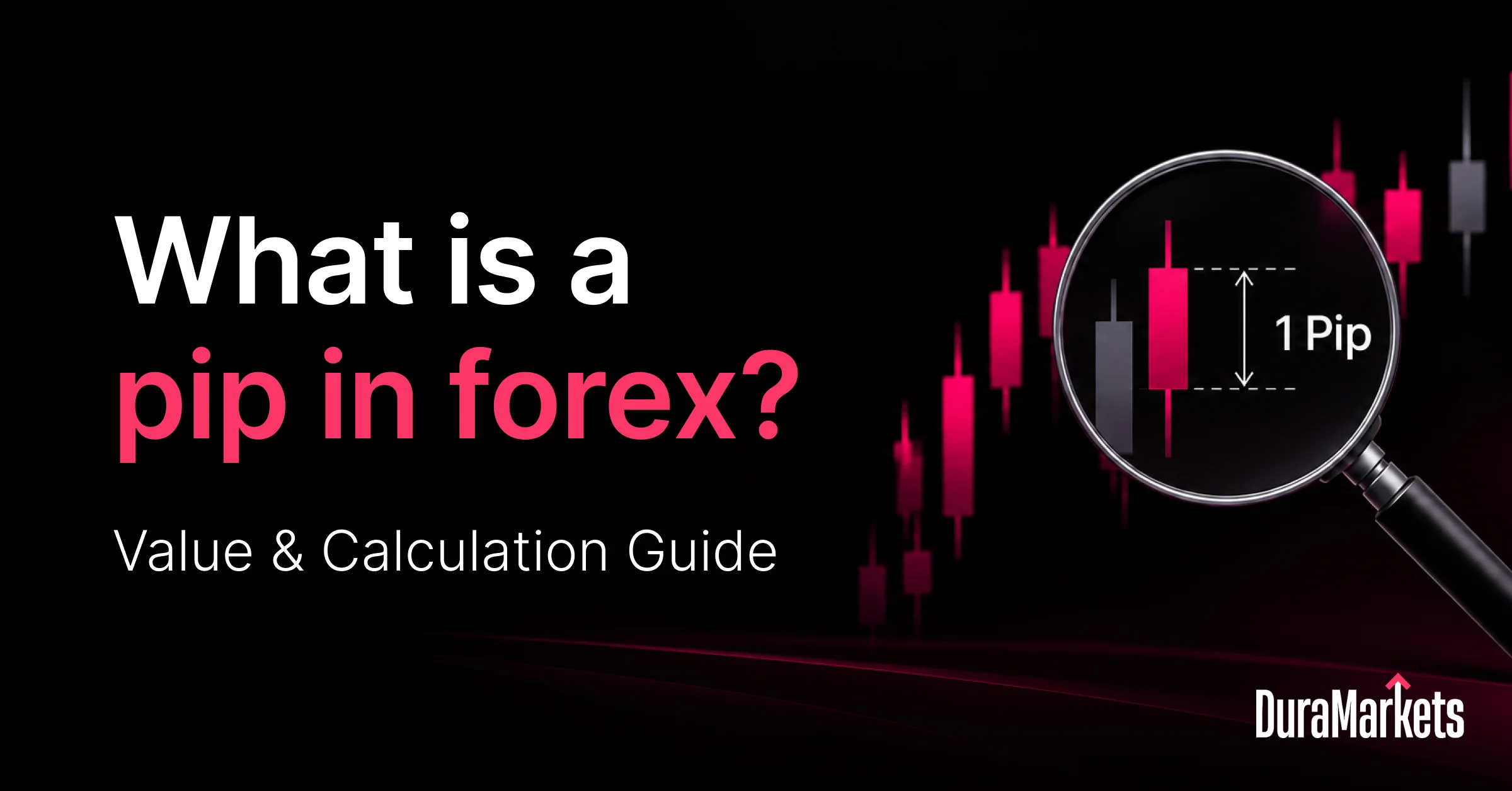
A pip, short for percentage in point, is a standard unit used to measure the change in a currency pair's price. For most pairs, one pip equals 0.0001; for JPY pairs, one pip typically equals 0.01.
For example, if EUR/USD moves from 1.1000 to 1.1001, it has risen by one pip. If USD/JPY moves from 150.20 to 150.21, it has also moved by one pip.
Pips provide a common way to describe price movements, compare spreads, measure stop-loss distances, and calculate trading results. However, a movement of 10 pips does not represent the same monetary amount for every trade. The financial impact depends on the position size and the currencies involved.
How Does a Pip Work in a Currency Pair?
A currency pair contains two currencies. The base currency is the first currency, while the quote currency is the second. The exchange rate tells you how much of the quote currency is needed to buy one unit of the base currency.
For example, in EUR/USD at 1.1000, one euro is worth 1.10 US dollars.
A pip measures the change in that exchange rate. To calculate the movement, compare the entry price with the exit price and divide the difference by the pair's pip size.
What Is One Pip in EUR/USD?
For EUR/USD, one pip is 0.0001.
-
Entry price: 1.1000
-
New price: 1.1001
-
Price change: 0.0001
-
Movement: 1 pip
If the price falls from 1.1000 to 1.0990, it has moved down by 10 pips.
What Is One Pip in USD/JPY?
For USD/JPY, one pip is typically 0.01 because the Japanese yen is quoted differently from most other major currencies.
-
Entry price: 150.20
-
New price: 150.21
-
Price change: 0.01
-
Movement: 1 pip
If USD/JPY moves from 150.20 to 150.00, it has fallen by 20 pips. Whether that movement produces a gain or loss for a trader depends on whether the position was long or short.
How to Calculate Pips in Forex?
The basic formula is:
Pips gained or lost = (Exit price − Entry price) ÷ Pip size
The pip size is generally 0.0001 for most pairs and 0.01 for JPY pairs. The formula gives a positive result when the exit price is higher than the entry price and a negative result when it is lower. Whether that means a profit or loss depends on the trade direction.
Forex Pip Calculation Example: EUR/USD
Suppose you buy EUR/USD at 1.1000 and close the trade at 1.1050.
-
Entry price: 1.1000
-
Exit price: 1.1050
-
Price difference: 1.1050 − 1.1000 = 0.0050
-
Pip size: 0.0001
-
Calculation: 0.0050 ÷ 0.0001 = 50 pips gained
Now consider a losing trade. You buy EUR/USD at 1.1000 and close at 1.0970.
-
Entry price: 1.1000
-
Exit price: 1.0970
-
Price difference: 1.0970 − 1.1000 = −0.0030
-
Calculation: −0.0030 ÷ 0.0001 = 30 pips lost
For a short trade, the interpretation reverses: a lower exit price than the entry price generally means a gain before costs.
What Is Pip Value in Forex?
Forex pip value is the monetary amount gained or lost when a currency pair moves by one pip for a particular position size. Pips measure price movement; pip value translates that movement into money.
For many USD-quoted pairs, such as EUR/USD, the approximate pip values for standard lot sizes are:
|
Position size |
Units of base currency |
Approximate pip value |
|
1 standard lot |
100,000 |
$10 per pip |
|
0.1 lot (mini lot) |
10,000 |
$1 per pip |
|
0.01 lot (micro lot) |
1,000 |
$0.10 per pip |
These examples assume the pip value is in USD and the pair's quote currency is USD. Pip values for other pairs, including USD/JPY, can change with the exchange rate. If your trading account uses a different currency, the value must also be converted.
For example, if you trade one standard lot of EUR/USD and the market moves 20 pips in your favour, the approximate price-based gain is $200 before spreads, commissions, swaps, and other costs. The same 20-pip move against the position would mean an approximate $200 loss before costs.
A pip calculator, sometimes called an FX pip calculator, can estimate the monetary value of a pip using the currency pair, position size, and account currency. This is useful when planning a trade and checking whether the potential loss fits your risk limit.
What Is a Pipette?
A pipette is one-tenth of a pip. Many brokers quote currency prices to an extra decimal place, allowing traders to observe smaller price changes.
For example, EUR/USD might be displayed as 1.10005 instead of 1.1000. The final digit represents a pipette when the pair uses the conventional 0.0001 pip size.
For most non-JPY pairs, one pipette is 0.00001. For JPY pairs, it is typically 0.001. The number of displayed decimal places can vary by instrument and broker.
Pip vs. Pipette: What Is the Difference?
The difference is the size of the price movement each unit represents. One pip equals 10 pipettes.
|
Measurement |
Most currency pairs |
Typical JPY pairs |
|
1 pip |
0.0001 |
0.01 |
|
1 pipette |
0.00001 |
0.001 |
|
10 pipettes |
1 pip |
1 pip |
Pips are commonly used to describe trading results and stop-loss distances. Pipettes provide more precision when prices are quoted to an additional decimal place.
How Do Spreads and Stop-Loss Orders Relate to Pips?
The spread is the difference between a currency pair's bid price and ask price. Brokers commonly express this difference in pips.
For example, suppose EUR/USD has an ask price of 1.1002 and a bid price of 1.1000. The spread is 0.0002, or 2 pips. A trader buying at the ask and immediately selling at the bid would face that price difference, before any other costs or price changes.
A stop-loss order sets a price level at which a position should close if the market moves against it. If you buy EUR/USD at 1.1000 and place a stop-loss at 1.0970, the stop-loss distance is 30 pips.
However, the distance does not guarantee the exact amount you will lose. In fast markets or during price gaps, the order may execute at a different price. Position size, spreads, slippage, and other costs can all affect the final result.
The question of what is a good spread in forex depends on the currency pair, market conditions, account type, and trading strategy. A spread that may be manageable for a longer-term trade could be significant for a scalper targeting only a few pips.
What Should Beginners Remember About Forex Pips?
Understanding pips is an essential part of learning to trade forex, but counting pips alone is not enough to evaluate a trade.
Before entering a position:
-
Identify the pair's pip size. Most pairs use 0.0001, while JPY pairs typically use 0.01.
-
Calculate the price difference. Compare entry and exit prices and divide the difference by the pip size.
-
Convert the movement into money. Use position size, pip value, and account currency to estimate the financial impact.
-
Account for trading costs. Include spreads, commissions, swaps, and possible slippage.
-
Manage risk. Set a suitable stop-loss and position size based on how much you can afford to lose.
Pips help standardise price movements, but they do not tell you whether a trade is suitable or profitable. Sound risk management remains essential.